Maritime Sanctions Evasion Tactics: Unmasking Cyber-Infrastructure Used by Iranian and Russian Fleets
Executive Summary
A network of Iranian and Russian shadow fleet vessels is leveraging online platforms fashioned to facilitate sanctions evasion. These platforms encompass counterfeit websites mimicking legitimate ship registries, national authorities, training organizations, indemnity clubs, and classification societies, effectively replicating essential maritime compliance layers. Such a setup probably enables the creation and validation of fraudulent documentation and certificates to circumvent compliance checks.
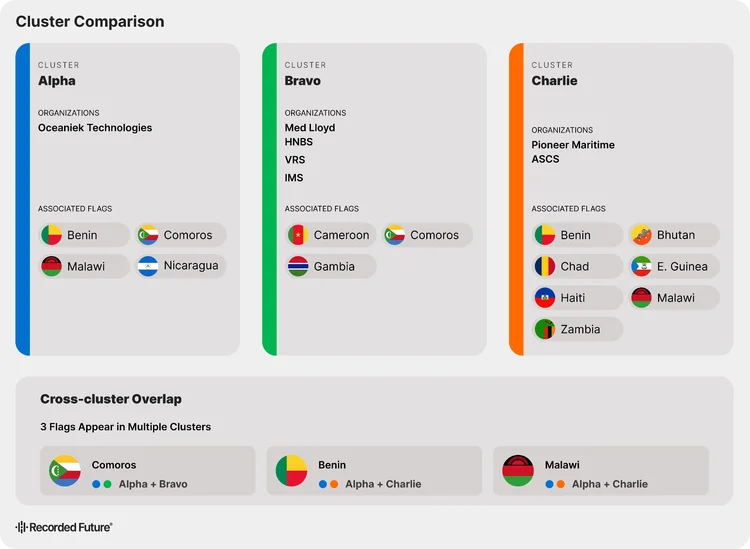
This online architecture aligns with a service-provider model where bad actors offer reusable digital tools, documents, and identities, rather than functioning as specialized, nation-specific units. Three specific clusters of activity—labeled Alpha, Bravo, and Charlie for clarity—exhibit several overlapping technical traits, hinting at a larger, loosely interconnected ecosystem backing multiple sanctions evasion networks (SENs). This observation is corroborated by previous findings reported by Bellingcat and Lloyd’s List, suggesting potential links across these clusters. It raises unsettling questions about the integrity of maritime regulatory frameworks and enforcement capabilities.
The tactics displayed here merge traditional sanctions evasion methods—exploiting lax jurisdictional oversight in less regulated areas for fraudulent ship registrations—with modern cyber techniques like automated document generation and layered infrastructures designed to create believable but false documents and shell companies, complicating both detection and enforcement efforts. This combination of old and new strategies not only reflects the ingenuity of these actors but also their ability to adapt to regulatory changes, making them even harder to track.
These cyber-enabled SENs are likely eroding sanctions compliance mechanisms by fabricating credible yet fictitious maritime organizations, thereby increasing the risks of due diligence failures and regulatory scrutiny. Entities operating within the maritime and shipping sectors are advised to incorporate independent verification and cyber threat intelligence into their compliance workflows, enabling preemptive identification of fraudulent online infrastructures. Governments that find their authoritative identities misused by SENs and their associated service providers should prioritize coordinated efforts to identify and dismantle these false infrastructures, especially when actors claim multi-jurisdictional legitimacy. Without proactive measures, the scope for evasion will only continue to widen.
Key Findings
- Research indicates SENs linked to Iranian and Russian shadow fleets are utilizing over 36 counterfeit websites across three distinct clusters. Notably, Insikt Group has established connections between these websites and seventeen vessels, many of which are already under sanctions from the U.S. Department of the Treasury (USDT) and other nations. This suggests a well-coordinated effort to operate under the radar of international authorities.
- The fraudulent sites impersonate various national maritime authorities and ship registries from several countries, including the Comoros, Benin, Bhutan, and others. This tactic not only creates a facade of legitimacy but also complicates provenance tracking for regulatory bodies trying to enforce sanctions.
- In addition, some websites aim to falsely create ship classification societies that appear legitimate, along with numerous platforms posing as seafarer training, certification organizations, and indemnity clubs. The spread and sophistication of these false entities signify how readily these malicious actors can mimic established maritime processes.
- One particular website mimics the Benin Maritime Administration, offering a tool for generating counterfeit seafarer documents for Benin, Comoros, and Nicaragua. The implications here are that not just the shipping vessels, but also the personnel facilitating their operations could potentially be operating under fraudulent credentials.
- Attribution details suggest Cluster Alpha may partly stem from an Indian web development firm, Oceaniek Technologies, while Cluster Bravo connects to two Syrian individuals, one with prior illicit activity links. Cluster Charlie remains unattributed but shares characteristics with Cluster Bravo. The geographical dispersion of these entities underscores the transnational nature of the operations.
Background
The three clusters of online platforms likely support both Iranian and Russian shadow fleets in their sanctions evasion operations (see Figure 1). These clusters—Alpha, Bravo, and Charlie—are interconnected via shared infrastructure, consistent domain registration schemes, and repeated operational security errors. Such overlaps not only signify a collective effort but also hint at a deep-rooted network capable of replicating their operations across multiple jurisdictions.
This activity intersects with previously described clusters reported by Bellingcat and Lloyd’s List, linking some activities to Oceaniek Technologies and potentially to a series of fraudulent ship registries associated with the domain marinegov[.]net. This suggests a possible continuity of operations and lessons learned among those committing these illegal acts, adapting swiftly to regulatory challenges.
Unlike conventional cyber intrusion schemes, these websites facilitating maritime fraud and sanctions evasion constitute a multifaceted network incorporating front companies, personal identities, and vessels. Nonetheless, Insikt Group established initial attribution for one cluster to two Syrian nationals, at least one of whom has documented involvement in illegal activities. This points to a concerning trend where expertise in illicit activities merges with technical capabilities to create a resilient network.
Future Implications
The ongoing activities of these shadow fleets raise significant concerns for global maritime security. If they're not addressed effectively, we may witness a further proliferation of these fraudulent practices, enabling bad actors to challenge international sanctions more openly. As the maritime industry evolves alongside technology, it may become increasingly important to integrate advanced monitoring systems capable of real-time detection of such fraudulent activities.
What this means for you, especially if you're working in this space, is that traditional compliance measures may no longer suffice. Entities must embrace a more dynamic and tech-savvy approach to ensure that the layers of complexity introduced by these clusters do not overwhelm compliance frameworks or enforcement protocols.
So what’s next? Countries around the world will need to collaborate to bolster their maritime regulatory frameworks while simultaneously addressing the cyber vulnerabilities these networks exploit. Coordination will not just aid in identifying these elaborate scams but will be vital in creating a more resilient maritime environment against such encroachments. (and this is the part most people overlook) Implementing cyber threat intelligence-sharing frameworks, much like existing intelligence-sharing protocols among nations, will play a pivotal role moving ahead.