March 2026 CVE Report: Identifying Critical Weaknesses and Ransomware Exploits in Leading Software
March 2026 has revealed a significant threat landscape, as Insikt Group® highlighted 31 vulnerabilities requiring urgent attention, with 29 of these earning a Very Critical Recorded Future Risk Score. The affected platforms span multiple vendors, most notably Microsoft and Apple, which together make up about 32% of the identified vulnerabilities.
Long-Neglected Vulnerabilities Resurface
A particularly concerning finding is the emergence of long-neglected vulnerabilities, such as CVE-2017-7921, relevant to Hikvision and dating back nearly a decade. This highlights a persistent issue where attackers exploit older vulnerabilities, especially in environments where timely patching fails. Vulnerabilities don’t age out of relevance; in fact, they often become prime targets for malicious actors who prey on organizations that neglect to update their systems. The cybersecurity community has long warned that outdated software remains an easy entry point for attackers. Prioritizing older CVEs based on recent activity could strengthen defenses against such exploits.
Analytical Trends for March 2026
This latest assessment indicates that among the most exploited vulnerabilities, deserialization issues (CWE-502) and code injection flaws (CWE-94) are the most frequently observed. These types of vulnerabilities have been a recurring theme in the cybersecurity discourse due to their commonality across various applications. The evaluation of March also uncovered compelling links between malware campaigns and the vulnerabilities, revealing how attackers are not just randomly selecting targets but are instead driven by a meticulous strategy that targets specific weaknesses:
- The Interlock Ransomware Group's exploitation of a zero-day vulnerability in Cisco Secure Firewall Management Center, enabling them to infiltrate networks and deploy custom-made remote access trojans (RATs).
- Another significant threat stems from the DarkSword iOS exploit, allowing for remote code execution (RCE) and subsequent kernel-level access through Safari.
This month, 9 of the 31 highlighted vulnerabilities facilitated remote code execution, affecting platforms from a diverse array of providers such as Google, Apple, and Microsoft. Vulnerability management teams must remain vigilant and prioritize remediation efforts aligned with observed exploit activity. Ignoring these threats could bolster the success of ransomware campaigns and other forms of cybercrime.
Exploit Case Study: Interlock Ransomware and Cisco FMC
On March 18, 2026, Amazon Threat Intelligence reported on a sustainable campaign by the Interlock Ransomware Group using CVE-2026-20131, a critical flaw within the Cisco Secure Firewall Management Center (FMC). This vulnerability allows attackers to execute arbitrary Java code with elevated privileges on unprotected devices. Notably, exploitation began on January 26, 2026, indicating prior knowledge and activity before its public finding. This is more significant than it looks; attackers had time to craft their strategies and amplify their efforts before any substantial defensive measures could be put in place.
The attackers exploit this vulnerability by sending crafted HTTP requests to gain access, followed by deploying malicious binaries intended for further exploitation. Their methodologies involve utilizing Java and JavaScript-based RATs along with advanced evasion techniques. With these tools, they're positioning themselves for lateral movement within compromised networks and data extraction. If you’re in cybersecurity, you should watch this progression closely; it highlights how quickly a simple oversight can lead to extensive network penetration.
When deploying these malicious tools, the ransomware group employed various techniques, such as reconnaissance and privilege escalation. Samples of their activity demonstrated a capacity for altering machine behavior to avoid detection. (And this is the part most people overlook.) By modifying desktop backgrounds and employing delays to confuse detection mechanisms, attackers can outsmart basic security measures, making it even harder for incident response teams to mitigate these threats.
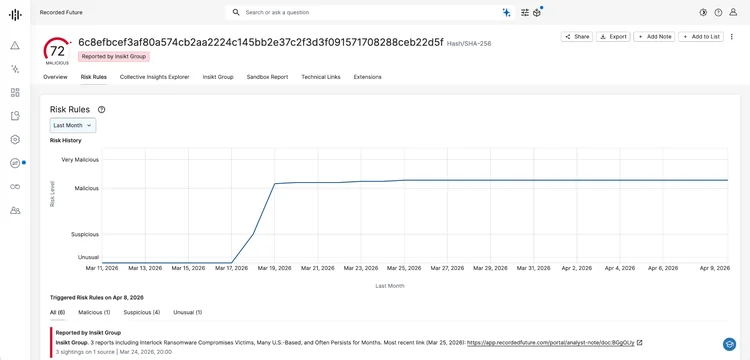
March 2026 Vulnerabilities Overview
Below, you will find a summary of the critical vulnerabilities identified in March, with corresponding risk scores, affected vendors, and types of vulnerabilities:
| # | Vulnerability | Risk Score | Affected Vendor/Product | Vulnerability Type/Component | Public PoC |
|---|---|---|---|---|---|
| 1 | CVE-2026-20131 | 99 | Cisco Secure Firewall Management Center (FMC) | CWE-502 (Deserialization of Untrusted Data) | Yes |
| 2 | CVE-2026-21262 | 99 | Microsoft SQL Server | CWE-284 (Improper Access Control) | No |
| 3 | CVE-2026-26127 | 99 | Microsoft .NET | CWE-125 (Out-of-bounds Read) | No |
Table 1: The list of actively exploited vulnerabilities in March 2026 based on Recorded Future's analysis, highlighting potential public proof-of-concept exploits.
Implications and Future Outlook
The threats present in March represent a clear signal for organizations to amplify their vigilance and patching protocols. As attackers continue to exploit both new and legacy vulnerabilities, consistent monitoring and resource allocation toward remediation are paramount to maintaining a strong security posture. The emergence of effective exploit kits, along with ongoing campaigns targeting well-known products, emphasizes that static defenses aren’t enough. Organizations must adopt a dynamic approach to cybersecurity that recognizes the fluid nature of threats.
The patterns observed in this analysis indicate a troubling trend: vulnerabilities are not merely numbers; they reflect a broader risk profile that organizations face daily. Ignoring or underestimating potential exploit activity could lead to breaches with severe financial and reputational repercussions. As cybersecurity experts emphasize, the cost of prevention is significantly lower than the cost of dealing with a breach.
Ultimately, vulnerability management strategies must evolve to address the intricacies of today's threat environment. Identifying, understanding, and mitigating risks is a continuous cycle that demands ongoing commitment and investment. As complexity increases, organizations should consider either bolstering existing strategies or pursuing partnerships with specialized security providers, to stay ahead of attackers who are growing increasingly sophisticated.