Significant Vulnerabilities Identified in April 2026: A Call to Action for Security Teams
In April 2026, a total of 37 significant vulnerabilities were flagged for urgent attention by the Insikt Group®, with 35 earning a Very Critical Recorded Future Risk Score. This marks a 19% increase compared to the previous month, underscoring a worrying trend in emerging threats. With this surge, organizations must consider whether their current security measures can withstand the growing onslaught of vulnerabilities. The data highlights the urgent need for proactive measures, especially in an increasingly interconnected digital environment where the repercussions of a single vulnerability can extend across networks and systems.
Vendor Vulnerability Breakdown
Among these vulnerabilities, 31 were documented in the US Cybersecurity and Infrastructure Security Agency (CISA)’s Known Exploited Vulnerabilities (KEV) catalog, while an additional six vulnerabilities were identified exclusively through honeypot data—a service accessible only to Recorded Future customers. This distinction is crucial: honeypot data often provides insights into emerging threats before they become mainstream. By analyzing attack vectors in real-time, organizations can better prepare for similar exploits on their systems.
The vulnerabilities spanned products from 23 different vendors, with Microsoft representing a noteworthy 22% of the total exposure. This is more significant than it looks. Microsoft’s vast footprint in both enterprise and consumer markets means that when vulnerabilities emerge in its products, the potential for widespread impact grows exponentially. Other problematic areas included various enterprise-facing vendors, particularly those involved in security and system management tools, collaboration platforms, application delivery software, and network-edge infrastructure. These sectors are vital for organizational cohesion and data integrity; thus, any exposure can lead to operational disruptions and data breaches.
Vulnerability Overview for April 2026
Below is a summary of the vulnerabilities that were actively exploited during April 2026, excluding the six linked to honeypot activities.
Score
✓
(available to Recorded Future Customers)
Table 1: Active vulnerabilities for April 2026 based on Recorded Future data (excluding honeypot-sourced CVEs).
Key Insights: April 2026
- Ransomware activity was linked to seven of the identified vulnerabilities, with six specifically tied to the Storm-1175 group's Medusa operations. This correlation highlights how cybercriminals are increasingly targeting software vulnerabilities as entry points for ransomware.
- Sixteen vulnerabilities enabled remote code execution (RCE), impacting products from major vendors including Adobe and Microsoft. The ramifications here are severe; RCE vulnerabilities allow attackers not only access but also the ability to control affected systems, opening the door to extensive system manipulation.
- Public proof of concept (PoC) exploits were identified for 24 of the vulnerabilities, indicating active attempts at exploitation. This urgency from attackers should raise alarms about the vulnerability management strategies employed by organizations; if attackers are already developing practical exploits, the window for defensive action is rapidly closing.
- Common vulnerabilities included path traversal and code injection flaws, with several assessed as being over five years old, highlighting the persistent threats of long-standing weaknesses. Organizations should reassess their patch management practices: Are they adequately addressing legacy vulnerabilities as well as newly discovered issues?
Detailed Exploitation Insights
This section emphasizes key vulnerabilities that are actively exploited, especially those connected to known threat actor campaigns or those for which Insikt Group has created detection templates.
Nexcorium and TBK DVR Vulnerability
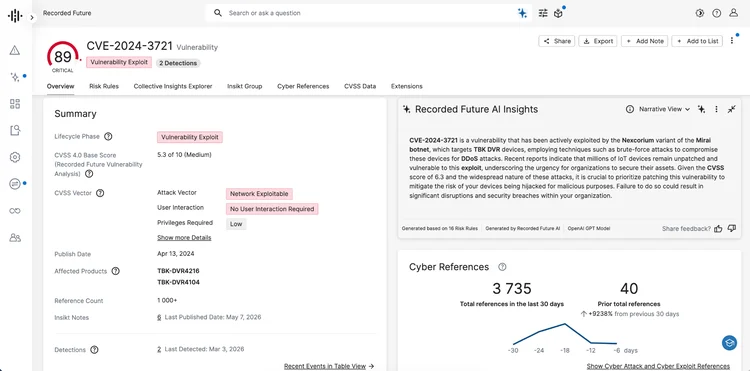
On April 17, 2026, FortiGuard Labs detailed a vulnerability-driven campaign exploiting TBK Digital Video Recorder devices to deploy the Nexcorium botnet. The specific vulnerability, CVE-2024-3721, is an OS command injection flaw that allows attackers remote access to execute system commands. This situation illustrates how even seemingly innocuous devices can become focal points for broader attacks. The implications of such exploitation can result in catastrophic breaches, particularly when these devices are part of critical infrastructure.
The process begins when attackers exploit CVE-2024-3721 by sending crafted requests to the affected TBK DVR systems, enabling the execution of a script named dvr which downloads Nexcorium binaries. Attackers leveraging such attack vectors underscore a broader trend: exploiting Internet of Things (IoT) devices that organizations might underestimate regarding their security posture.
In addition to this specific vulnerability, Recorded Future customers benefit from Malware Intelligence queries that reveal samples tied to known network indicators, enhancing threat detection and response strategies. This additional layer can make a significant difference in early detection and remediation, preventing similar attacks from succeeding elsewhere.
Implications for Organizations
For those working in cybersecurity or IT management, the trends from April 2026 should serve as a wake-up call. The extensive vulnerabilities identified highlight systemic issues in vulnerability management and security hygiene. As organizations continue to digitize operations, they must review not just which products they use but also how quickly they respond to threat alerts. A staggering 19% increase in flagged vulnerabilities in just one month suggests that cyber adversaries are ramping up activity.
The focus should also be on vulnerability prioritization. Resources are finite, and organizations must allocate them effectively based on potential impact, rather than simply responding to vulnerability lists. This means understanding the implications of each identified vulnerability, the critical systems that might be affected, and the associated risks. Prioritization assessments should be ongoing, not done once and forgotten. Failure to act could mean exposing critical business processes to unnecessary risks—in many cases, you won't get a second chance.
Indeed, as technology advances and threats adapt, organizations that continue to treat cybersecurity as an afterthought may find themselves facing severe consequences—financial loss and reputational damage, not to mention regulatory scrutiny. And yet, this is a scenario that can be prevented with the right combination of foresight, preparation, and proactive remediation strategies.