AI Automation Can Outrun Human Oversight: Lessons From Hiring
AI systems can move faster than people can supervise them. Hiring shows what happens when organizations respond to rising machine-driven volume with more automation: the process speeds up, but human judgment gets squeezed out. My read is that effective oversight depends less on inserting a person into every step and more on setting clear boundaries for what agents can do, where human review matters, and when a process should slow down. That distinction matters because a checkpoint is only useful if someone has enough context and time to make a meaningful decision. A person who can only approve a machine’s recommendation under pressure may be present in the workflow without providing much oversight.
Hiring’s automation loop
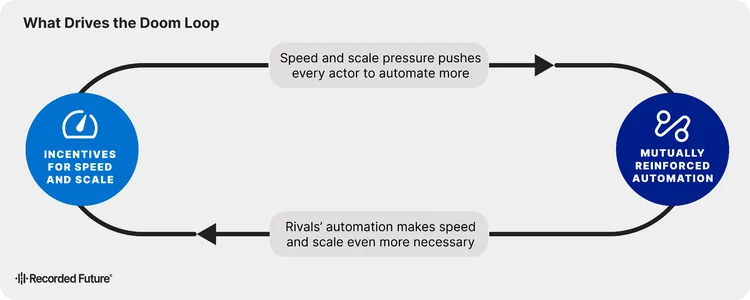
Generative AI has made it easy to produce tailored applications at scale. Candidates can apply to hundreds of jobs, while employers turn to automated screening to handle the influx. Greenhouse’s CEO has called the result a “doom loop”: each side’s use of automation pushes the other to rely on it more. The label captures a familiar problem in systems shaped by competing incentives: a choice that helps one participant cope with pressure can add to the pressure everyone faces. Applicants want to be seen, and employers want to process applications. Automation serves both aims, at least in the short term.
The numbers point to a sharp change in volume. One survey of hiring managers found that applicants per hire tripled from 2021 to 2024. Greenhouse reported a 412% increase in applicants per job posting. Job seekers are almost certainly using generative AI to create customized applications for large numbers of roles. These measures describe different parts of the hiring process, but they point in the same direction: employers face more material to assess, while each candidate has a stronger reason to send more applications. More applications do not necessarily mean more qualified candidates. They do mean that a hiring team needs a way to distinguish signal from repetition.
Employers have responded with automated filters and, in some cases, AI-led interviews. Ninety-one percent of HR departments say they use AI in recruitment. Greenhouse data shows that the number of human recruiters has fallen by more than half. At that scale, remaining recruiters have little opportunity to assess each application closely, and candidates may not speak with a company employee until late in the process—or at all. That changes what the process can reliably measure. A filter can compare applications against criteria, but the decision to interview, hire, or reject still depends on what an employer values and whether the available evidence supports that judgment.
More automation hasn’t delivered a faster process
The efficiency case is weaker than the adoption figures suggest. Only one-third of recruiters said AI had improved time to hire; a quarter said hiring had become slower. Some employers are extending probation periods, which may reflect difficulty identifying poor fits before making an offer. Automation can reduce work in one stage while adding friction elsewhere: candidates may be screened more quickly, but employers still have to resolve uncertainty about who is suited to the role. The result can be a faster first filter without a faster or more confident decision.
Applicants have also voiced frustration at dealing with bots instead of people. That reaction is more than a complaint about convenience. A hiring process also gives candidates a chance to understand the employer and gives employers a chance to assess communication beyond written application materials. If those exchanges are postponed or removed, both sides make decisions with less direct information. And a process that feels impersonal may make it harder for candidates to trust that anyone has considered their application carefully.
Automated workflows create another opening for abuse: scammers and state-sponsored cybercriminals have used hiring processes to advance candidates seeking access to company secrets or cryptocurrency. This is a reminder that recruitment is not just a queue to clear. It can also be a route into an organization, where a mistaken decision may carry consequences beyond a poor match for a role. The more a process depends on automated signals, the more attention employers need to give to what those signals can and cannot establish. Volume makes review harder; it doesn’t make the underlying decision less consequential.
Hiring was especially exposed because employers had already adopted tools such as keyword-based resume filters, and application materials tend to follow formats that generative AI can reproduce convincingly. But the forces behind the loop reach beyond recruitment. When speed and scale are rewarded, people are pushed to do more in less time. As volume rises beyond what individuals can manage, organizations automate more steps, prompting others to optimize for the automated system. The same pattern can emerge wherever people and organizations adapt to a machine-mediated process: each side learns how to get through it, and the process itself can drift away from its original purpose.
Design oversight around intent
The cycle is sustained by two pressures: candidates benefit from applying to more jobs quickly, and employers automate further as applications exceed their capacity. Candidates then focus on satisfying screening systems rather than communicating with future colleagues. Each decision can appear practical on its own; together, they can undermine the purpose of hiring. That’s the part most organizations should examine: whether the system is helping people make a better decision, or simply helping them process more activity. A larger flow of applications and faster screening may look like progress while leaving the central question unresolved—who is a good fit, and why?
That’s the wider lesson for teams deploying AI agents. Adding a human checkpoint to every machine-speed action may be impractical, while relying on people to catch every failure leaves oversight overwhelmed. Leaders need to define which tasks can run at speed, what constraints keep agents within human-authorized intent, and which decisions carry enough risk to require human review. Those boundaries need to be clear enough that people know when to intervene and what information to consider; otherwise, review risks becoming a procedural pause rather than a check on the system’s judgment. If you’re working in this space, the practical question is where a mistake would change the outcome for someone, and whether a person can still influence that outcome in time. A human in the loop, on paper.
This is more significant than it looks: the hiring loop shows that oversight is partly a design problem, not just a staffing problem. A process can include people and still leave them too little time, context, or authority to shape its decisions. Effective controls need to account for how users respond to the system, including the incentives that push them to produce more inputs or trust automated filters. That means monitoring whether the process is still serving its stated purpose, not simply whether it is running quickly. Hiring offers a plain warning for agent deployment: automation should manage scale without erasing the human judgment the process depends on. And yet, that judgment only counts when the workflow gives people a real opportunity to use it.