Gathering for the first time, the Three.js community is uniting at a specialized conference that promises to blend creativity and technology. This event is an exciting opportunity for developers, designers, artists, and enthusiasts to connect and share insights under one roof.
If you can’t attend in person, don’t worry. Codrops is on-site, covering everything as it unfolds!
Our team, including Houmahani Kane, Adel Sanaa, and Rafael Teixeira, will be capturing all the talks, demos, and casual interactions as they happen, giving you a virtual window into this vibrant gathering.
Stay tuned for our updates — you'll get to experience the conference moments, discoveries, and highlights right alongside those who are there in Paris.
The excitement is palpable even before the event kicks off. The venue buzzes with energy, as attendees filter in and preparations reach their final stages. After months of buildup, the inaugural Three.js Conference is moments away from beginning.
Take a look at the pre-conference atmosphere in Paris, where everything is set to unfold. 🇫🇷
The Kickoff
And just like that, the conference launches into action. The air fills with enthusiasm as people settle in for the opening talks. This is more than just presentations; it’s the moment when a community fully converges for the first time, sharing their passion and ideas.
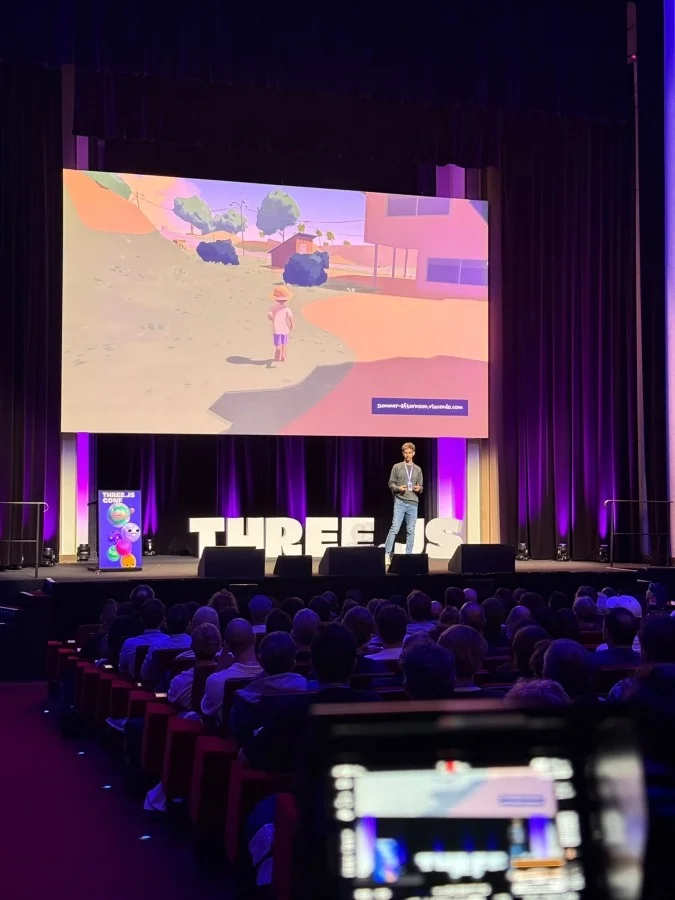
We’ve captured initial reflections from Paris, with highlights from keynote speakers like Vicente Lucendo and Robin Payot, who set the tone for an inspiring event.
The stunning stage!Welcome address by David Ronai
Diverse Perspectives from Opening Talks
Vicente Lucendo took the audience on a journey through the making of Messenger, sharing intricate details that contributed to the immersive experience. In a stark contrast, Robin Payot revisited childhood nostalgia, creatively reconstructing aspects of Zelda using Three.js while transitioning the project to WebGPU. This blend of artistry and technical depth set an impressive standard for the days ahead.
The presentations encapsulated a vibrant mix of nostalgia, innovation, and artistic expression. It’s a strong beginning to what promises to be an unforgettable conference. 👀
Years ago, their partnership with Three.js took flight through a creative project for Zenly, and since then, they’ve expanded their focus to encompass a variety of areas including interactive 3D, branding, motion design, and 3D illustration. Their vision for the Three.js Conf was to prioritize community engagement over a purely technical display of capabilities. This led to the creation of vibrant characters and a unique visual language that permeated every aspect of the event—from the website and promotional content to printed materials and the venue's aesthetic. They've also developed internal tools that maintain this visual coherence while allowing for flexibility. Notably, the Maison de la Chimie became an integral part of their creative vision, sparking fresh ideas for enhancing the experiential elements of the conference.
Some seemingly minor details blossomed into noteworthy projects of their own. Take the interactive 3D venue map; navigating the space felt more like engaging in a game than following a standard layout. Then there were the innovative speaker badges. Romain dedicated roughly a month to perfecting the electronics enclosure, turning the production into a family affair during the summer holidays. When he shared this saga on stage, it resonated with the audience, earning an enthusiastic round of applause. This anecdote underscored the uniqueness of an event that transcended being just a host for talks. It represented an entire visual universe, woven together through digital experiences and community interaction. 💙
The New Frontier of Creativity
The potential of AI in creative processes is nothing short of astonishing. It's reshaping how we transform ideas into tangible outputs, and this isn't limited just to productivity. The real power lies in the rapid translation of concepts into visual prototypes. When you can quickly see and test ideas, it opens the door to exploration—especially in fields reliant on visual representation. The speed of iteration can significantly enhance your understanding of what works and what needs refinement.
However, experience remains invaluable. Knowing how to craft and direct AI tools means you're not just a passive recipient of generated content. You're equipped to refine the process, spotting errors and adjusting outputs to better align with your vision. This skillset allows for a more personalized interaction with the technology, ensuring that the creative direction isn’t dictated solely by the algorithms.
This evolution is ushering in a new era where there's a significant expansion of space between what you can imagine and what you can execute. As more concepts flow from our minds into the real world, the landscape of creative work will fundamentally change. What's crucial here is recognizing that while AI can enhance our capabilities, human intuition and expertise still play a critical role.
If you're navigating creative industries, this transformation means reevaluating how you leverage these tools. Are you setting aside time to experiment and adapt, or are you merely following standard practices? Embrace these innovations not just as enhancements, but as fundamental shifts in how creativity can thrive.